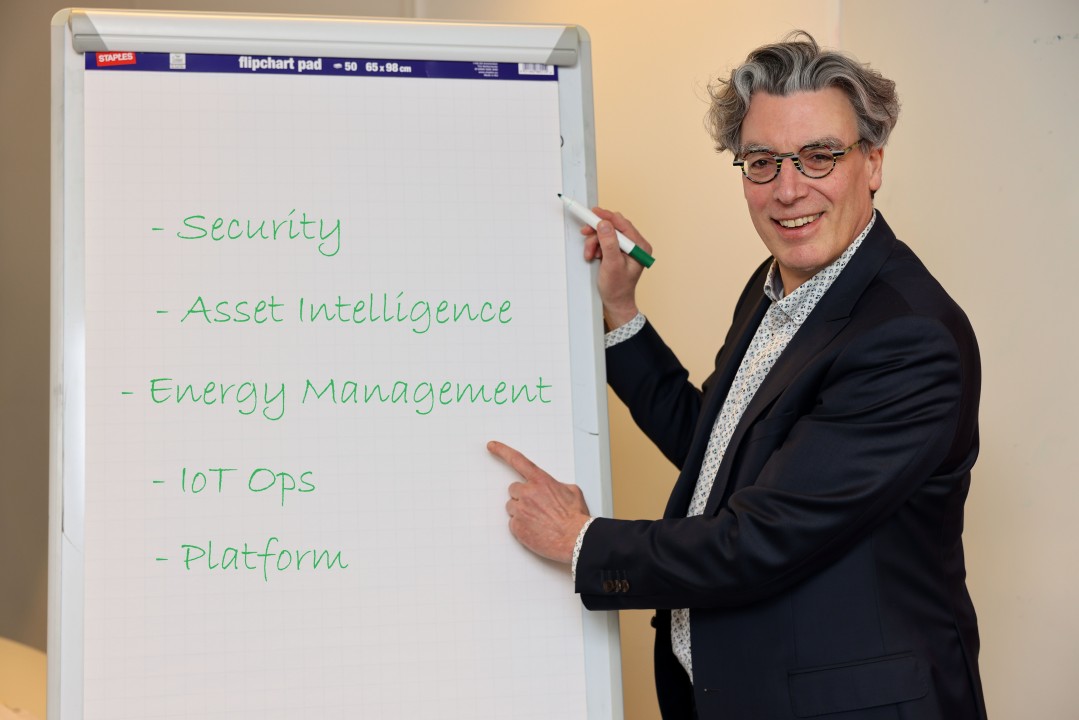
IoT is steadily evolving into a more mature, mainstream technology. It is remarkable how almost every new physical device can now connect to a central system and share its data.
This data fuels a wide range of applications, including condition monitoring, intelligent control through actuators and predictive capabilities powered by algorithms and artificial intelligence.
Based on our projects and market developments, I see 2024 as a pivotal year in the evolution of IoT. In this article, I share five emerging trends that demonstrate how IoT is becoming increasingly mature.
Trend 1: Security comes first: security by design in IoT
With the emergence of standards, security is no longer an optional extra for IoT device manufacturers. Security by design is now the norm, and the European cybersecurity directive for digital devices places responsibility on manufacturers to ensure security throughout the entire lifecycle. This includes secure initial installation, active identification of known vulnerabilities and regular distribution of updates and patches to keep devices secure.
The default approach for any organisation processing IoT data is to be extremely cautious about every connected device. IoT architecture embraces security by design and applies principles such as least privilege and minimising the attack surface. An open design makes auditing straightforward and provides clear evidence through logs and audit trails.
Security is a serious concern for every system, particularly IoT systems that interact directly with the physical world. A security breach can have serious real-world consequences and cause physical damage.
Trend 2: The rise of asset intelligence and decentralised decision-making
In an increasingly intelligent world, decisions are moving away from central systems towards embedded software and factory controllers. This decision-making is enabled by integrating logic, algorithms and artificial intelligence. Decisions are becoming more frequent and complex, with logic evolving beyond simple on/off commands towards more advanced optimisation settings.
These algorithms help systems achieve a desired outcome based on the operating priorities set by the owner of the device, machine or installation. These may include cost savings, improved employee safety, greater customer satisfaction, sustainability or a combination of these goals. As more parameters inform these decisions, their complexity increases.
Being able to explain decisions is essential for real-time intelligent operations. Decisions directly affect the physical world, and when an outcome is less desirable, understanding why it happened is crucial. Effective decentralised decision-making based on artificial intelligence requires traceability and audit trails, clear labelling of algorithm versions and training data, management of operating limits and clear emergency instructions.
Trend 3: The acceleration of sustainable energy management
Rising energy prices, economic and political uncertainty, and climate action have accelerated the use of digital technology for energy management and sustainability. The European Green Deal has led to stricter legislation requiring organisations to actively reduce their climate impact from greenhouse gas emissions.
Measuring and controlling energy assets plays a crucial role in increasing sustainable energy production and optimising energy consumption. The transition from fossil fuels to renewable electricity, for example, brings new challenges around grid congestion and the need for greater flexibility. Increasing numbers of digital meters and actuators are being added to the energy network, creating a real-time smart grid.
Trend 4: Proactive monitoring: a new era for IoT operations
The growing importance of IoT systems and the data supporting intelligent operations calls for a serious approach to running these systems. They have evolved from providing monthly status reports to supporting real-time decisions. This requires an entirely different level of operational management and monitoring.
Monitoring systems have become more proactive. They go beyond predefined alerts to anticipate unexpected increases or gaps in connected devices and data. They also actively monitor sensitive data from measurement sensors. Consider an outdoor temperature sensor used to optimise a building’s climate control system. If its reading suddenly changes from a typical 10°C in March to −50°C, that is still a valid temperature value. However, given Amsterdam’s maritime climate, a temperature drop of 60 degrees within a few days is highly unlikely. Such a reading could cause the climate control system to waste substantial amounts of energy. Detecting anomalies like these in incoming data is therefore essential.
IoT operations have evolved from best-effort services into business-critical systems, requiring robust capabilities for rapid service recovery and data feed failover. This is vital because a service interruption can have serious financial or even physical consequences.
Trend 5: Innovation in data integration and multi-source IoT platforms
IoT systems increasingly rely on a wide range of parameters to make informed decisions, requiring IoT platforms to integrate data from multiple sources and domains. This presents a challenge, particularly for larger organisations.
Combining data from multiple OT systems with planning data, customer preferences, supply chain information and external sources such as weather and traffic data can be complex. Data management is vital in this architecture, with a focus on consistent data use and the ability to use, exchange and compare data.
Alongside processing IoT telemetry data, engineers working on these platforms must also handle data from backend systems supplied by SAP, IBM and Oracle, as well as other ERP, planning and maintenance systems. IoT’s focus is shifting from sensors and connectivity towards integrating a vast range of data sources into a single platform.
Conclusion
IoT is clearly no longer in its infancy, but is steadily evolving into a mature, established technology. Its standard requirements, architecture, patterns and operational processes are now comparable to those of other complex systems requiring high availability. Our IoT baby has grown into a mature system, standing alongside other established technologies. And this is only the beginning of what promises to be an interesting journey towards further innovation in IoT.
Would you like to know more about the 5 IoT trends?