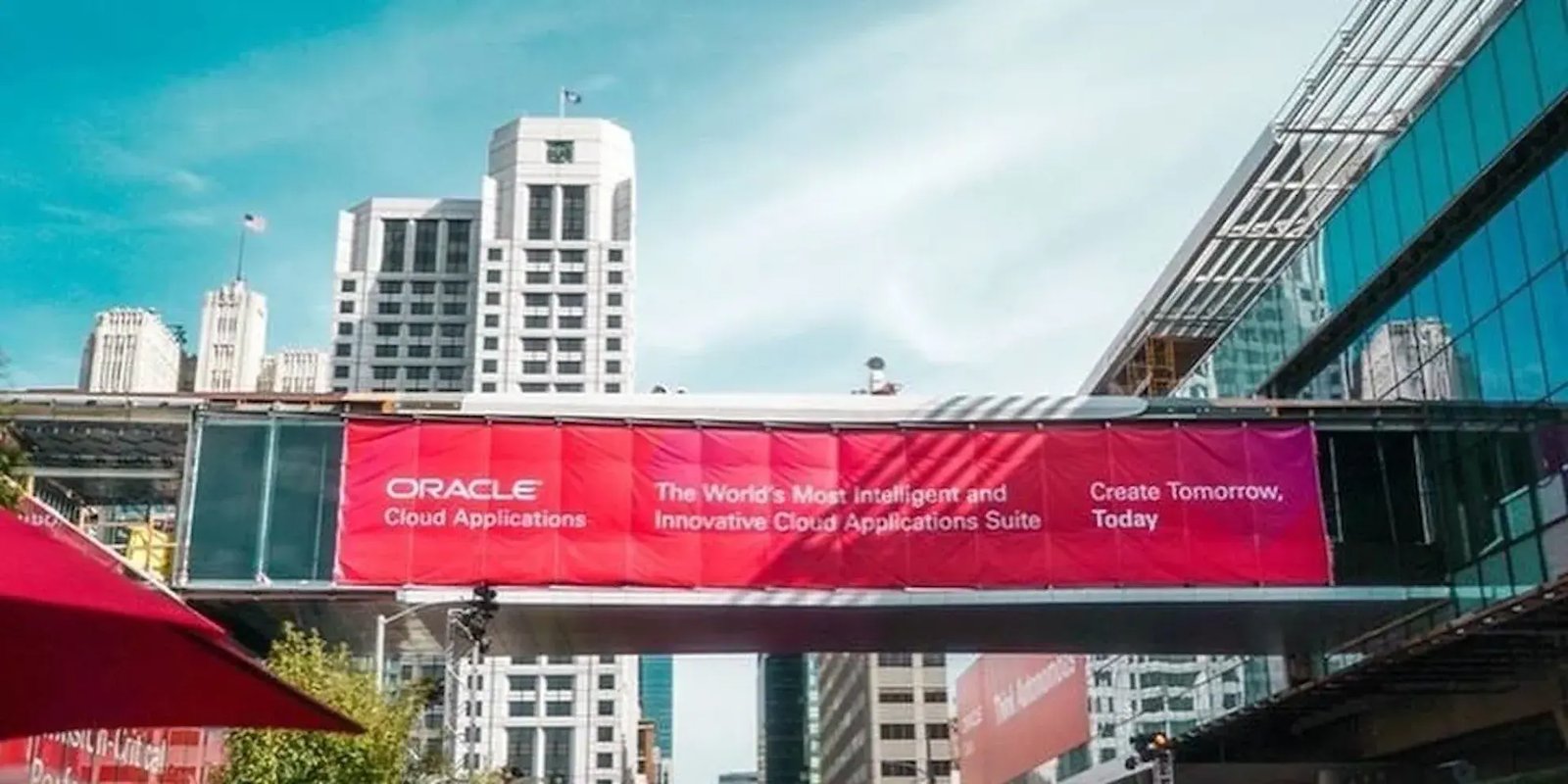
In this blog, AMIS CTO Lucas Jellema reports on his visit to Oracle OpenWorld and Code One in San Francisco in late October, where Oracle presented its strategy, new products and services, roadmaps and success stories for existing products.
On Monday 5 November, Robert van Mölken and Lucas Jellema from AMIS presented a detailed and insightful analysis of the annual Oracle OpenWorld conference at a well-attended session. The conference took place in San Francisco in late October. Oracle presented its strategy, new products and services, roadmaps and success stories for existing products. It also responded to major developments among competitors, in technology and in society.
Oracle’s CTO and thought leader Larry Ellison made it clear that Oracle has two strategic products: Cloud Infrastructure (OCI) and Business Applications (SaaS). Both are available in the cloud and on premises – under the same terms and with the same functionality.

Cloud Infrastructure
Oracle Cloud Infrastructure is a “Generation 2 Cloud” – a cloud that is substantially better than the existing solutions from both Oracle and its competitors. Oracle highlights the following technological features: dedicated bare metal compute nodes, a flat and therefore very fast network, Remote Direct Memory Access for extremely fast interactions within clusters, very fast (NVMe-based) storage, end-to-end security, fault domains and availability domains for high availability, and extreme compute shapes for demanding workloads requiring very large capacity or high speed. Oracle claims to be significantly cheaper than AWS, for example – particularly for storage and network traffic – and guarantees a bill that is more than 50% lower for database-as-a-service.
OCI is crucial to Oracle’s success. With it, Oracle hopes to finally offer a stable, scalable and manageable public cloud. Many specialists recruited by Oracle from AWS and Azure are involved in its development, contributing their experience and lessons learned.
OCI comes with a comprehensive, integrated set of services that matches or even exceeds what competitors offer. These services support cloud native computing, including managed Kubernetes (OKE, available since May 2018) and Container Registry, Serverless (Oracle Functions, early 2019) and orchestration (based on Terraform, early 2019). Customers pay no additional charges for these services; only their use of OCI infrastructure resources is billed.
"Oracle once used the slogan ‘Hardware and Software Engineered to work together’. It now seems to have been replaced by ‘Cloud and Software Engineered to work together’."
Autonomous
The distinctive capabilities of OCI and the features of the Oracle Database platform come together particularly in the Autonomous Database services – Autonomous Data Warehouse and Autonomous Transaction Processing. For example, they enable very high availability. It is worth knowing that Autonomous Database services use Exadata infrastructure.
The Autonomous Database takes many tasks off the DBA’s hands, from initial setup and routine administration to specific security and performance tuning activities. The standout feature in the 19c release, both in the cloud and on premises, is automatic index creation. This mechanism runs continuously in the background, seeking the optimal index design for the longest-running queries. Where necessary, these indexes are created, validated and made available to the optimiser. As new queries are introduced or data characteristics change, these indexes may be dropped and replaced by new, automatically created indexes.
The results achieved with this mechanism on standard applications such as NetSuite and EBusiness Suite are spectacular: in a very short time (days compared with years), and without expert involvement, an automated mechanism already delivers better performance.
SaaS Applications
Oracle sells an extensive range of business applications. These range from its own E-Business Suite and major acquired on premises applications such as PeopleSoft, Siebel and JD Edwards to Fusion Applications in the cloud and dozens of SaaS acquisitions. No vendor offers a broader range of horizontal – generic, cross-industry – applications for ERP (Enterprise Resource Planning), SCM (Supply Chain Management), HCM (Human Capital Management) and CX (Customer Experience). Oracle acknowledges Salesforce’s market leadership in CRM and sales support, but claims leadership in all other categories.
For Fusion Applications, Oracle announced innovations delivered on a strict quarterly release schedule. Key innovation themes include blockchain, Internet of Things, Artificial Intelligence & Machine Learning and Smart User Interfaces, such as Digital Assistant and applications that understand speech and context and proactively assist users.
Notably, for the first time since acquiring PeopleSoft and Hyperion and beginning the development of Fusion Applications, Oracle is actively encouraging customers to move from E-Business Suite, PeopleSoft and Hyperion on premises to SaaS, specifically Fusion Applications. Through its Soar programme, Oracle claims it can support this migration quickly using a proven approach. In line with its Applications Unlimited commitment, Oracle will also continue developing all products, including E-Business Suite and PeopleSoft, until at least 2030. Oracle does, however, promote migration to Oracle Cloud Infrastructure, offering tools, OCI reference architectures and Oracle Support services to facilitate this.
In Oracle’s view, customers should no longer need to develop custom applications, given the extensive SaaS offering available. In many situations, this requires SaaS enablement: integrating different applications, providing user interfaces that bring together data and actions from multiple systems, and delivering reporting & analytics based on consolidated data from several applications. Oracle offers its PaaS services for this purpose, giving customers access to the same powerful tools Oracle uses to build its SaaS applications.

SaaS Enablement & Custom Application Development
User interfaces come in different forms: a graphical user interface in a web browser (on a desktop or tablet) or a mobile app. There is now also the conversational user interface, where a person communicates with a chatbot through a chat dialogue. And, of course, there is the voice interface, an extension of conversational UI in which people speak rather than type.
For conversational UI, Oracle is launching Digital Assistant Cloud, an evolution of the chatbot component in Mobile Cloud. This Digital Assistant supports the development of logic to guide structured conversations, display the right information and perform actions. It also interprets users’ actual intentions from their unstructured input and responds accordingly. Oracle states that Digital Assistant will soon be able to conduct conversations through channels including Facebook Messenger, Slack, Skype for Business, Twilio and even WhatsApp (!). Amazon Alexa can also be used as a voice input channel.
For GUIs – web and mobile – Oracle has taken a major step in developing its SaaS applications: thousands of Oracle SaaS developers will use Visual Builder for new development, its low code tooling based on Oracle JET. This allows them to create business functionality visually and declaratively, making development fast and effective without requiring deep technical knowledge. Visual Builder also allows developers to incorporate custom JET Web Components where needed, combining the benefits of low code with the flexibility of custom coding.
Key announcements around Visual Builder include multilingual support, support for Progressive Web Applications (the new cross-device standard for mobile apps), integration with Developer Cloud for Git-based version control, deployment through Oracle’s global CDN (content delivery network) for fast loading times, and portable applications that can run independently of the cloud.
This means Oracle JET and Visual Builder (Cloud) are Oracle’s most prominent application development technologies, with ADF now taking a significant step back, as Forms did before it.
Learn more
The slides from the presentations given during the evening are now available on SlideShare. You can view them via these links:
We realise this is a lot of information. We would be happy to arrange a meeting to explain things in more detail and explore what these developments could mean for you.