
to intelligent asset operations
From operational data
A vehicle reports a technical anomaly, an escalator logs fault codes, and the maintenance history is stored in another system. The data is available, but employees have to work out what it all means together. How can you turn that information into better maintenance decisions? Intelligent Asset Operations connects real-time data, asset knowledge and day-to-day workflows.
There is plenty of data, but the connections are missing
Transport organisations manage a wide range of technical assets: vehicles, railway switches, power supplies, lifts and escalators. These assets generate data on their condition, performance and faults. This information is often spread across suppliers’ diagnostic systems, monitoring platforms and maintenance applications. When a fault occurs, employees have to combine information from different sources. Which alert relates to which installation? Has this problem occurred before? And does the situation require immediate action, or can an inspection be scheduled? Finding reliable answers takes time.
Intelligent Asset Operations brings together operational data, asset management, analytics and workflows. This creates a coordinated approach to assessing signals, preparing maintenance and learning from the work carried out.
From measurement to meaning
An Operational Data Platform (ODP) provides the foundation. It collects data from sensors, control systems and supplier applications and ensures reliable processing, even when connections temporarily drop or many devices send messages at the same time. To use this data, context is needed. An electric motor drawing more current is not necessarily worn out. The equipment may be operating under a higher load or in a different operating mode. Only by combining measurements with configuration details, operating conditions and maintenance history can a useful picture emerge.
This is where Asset Intelligence comes in. This layer connects technical signals with knowledge of an asset’s behaviour and function. Data from different manufacturers is mapped to common definitions so that analyses and processes can be reused wherever possible. Differences between installations remain relevant. Not every asset has the same sensors or sufficiently reliable data. If this makes an analysis impossible, the result must be ‘unable to assess’. Missing information must never be a reason to consider an installation healthy.
From an abnormal signal to a targeted inspection
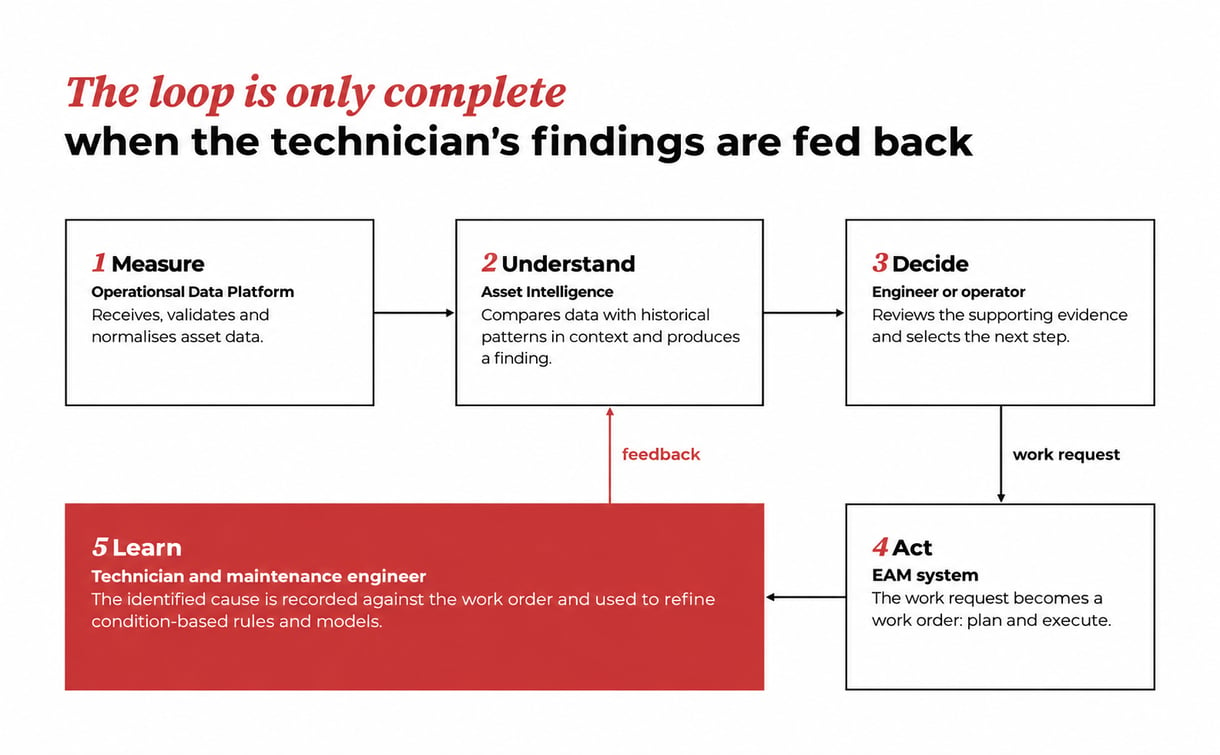
Suppose an escalator’s motor load gradually increases over an extended period while the equipment continues to operate. Monitoring with fixed thresholds may only trigger an alert once a threshold is exceeded. An integrated approach can highlight the changing behaviour earlier. The ODP collects and validates the measurements. Asset Intelligence compares the behaviour with previous patterns under similar conditions, taking into account the configuration, fault history and known causes of failure.
A maintenance specialist then receives a finding supported by evidence: which signals deviate from the norm, since when, and what are the possible explanations? Based on this information, the specialist can decide whether an additional inspection is needed. The work request is sent to the Enterprise Asset Management (EAM) system, where planning and execution take place. After the inspection, the technician records what was actually found. This feedback helps improve rules and models. This creates a continuous process of detecting, assessing, acting and learning. This creates a continuous process of detecting, assessing, acting and learning.
From measuring and understanding to deciding, acting and learning: the process behind Intelligent Asset Operations. This image was translated and edited using AI.
A clearer view of day-to-day operations
Operators also benefit from connected information. When a lift stops working, they need to assess its current status, recent faults, previous maintenance work and the impact on accessibility. An integrated workspace brings this information together. This helps the operator determine which situation needs attention and what the appropriate next step should be. The underlying systems retain their respective functions: the ODP processes operational data, Asset Intelligence supports assessment, and the EAM manages maintenance and work orders. Existing integration and data platforms retain their roles: an ODP complements these capabilities without rebuilding them. Reliable connections between these systems are essential. Each signal must refer to the correct physical asset, its current configuration and the corresponding maintenance record. Without these connections, even advanced analytics have limited practical value. The next article in this series explores the Operations Centre in more detail.
AI supports the assessment
AI can help at various stages. Anomaly detection identifies unusual behaviour that is difficult to spot using fixed thresholds. Diagnostic models help identify possible causes. Predictive models estimate how wear or the risk of failure will develop. Generative AI can also search and summarise maintenance instructions and previous incidents, with references to the sources used. AI agents can gather information or prepare a work request.
The right application depends on the operational challenge and the available data. Sometimes, a clear condition-based rule is sufficient. For safety-critical assets, it must also be clear who makes a decision, what evidence is required and how errors are corrected.
Start with one specific maintenance challenge
The move towards Intelligent Asset Operations requires collaboration between IT, OT, asset management, maintenance and operations. Employees need to understand what a signal means, who assesses it and who is responsible for follow-up. Agree in advance who approves changes to condition-based rules and who is accountable when a valid alert does not lead to timely action. Training, data quality and the management of rules and models must also be part of the approach from the outset. Start with one application that can deliver clear operational value, such as investigating recurring faults in a piece of equipment. From the start, establish the foundations for reliable data processing, asset identification, security and integration with the maintenance process.
Establish a baseline and acceptance criteria in advance, then assess the impact in practice. Are anomalies detected earlier? Are work requests better supported by evidence? How many alerts turn out to be false alarms? And does the information help improve maintenance preparation? Not every application delivers sufficient value, and not every asset requires predictive maintenance. By working step by step, an organisation can make targeted adjustments and expand successful applications.
AMIS Conclusion’s role
AMIS Conclusion designs, builds and manages the real-time data, IoT and integration capabilities that support this approach. We connect data from physical assets to the systems and processes employees use every day. Reliability, security and ongoing management are part of the design from the outset. Together, we determine which operational challenge to address first and what capabilities are needed. Starting with a specific application, we build a foundation that can also support future applications.
Would you like to make better use of existing asset data for maintenance and day-to-day decision making?
We’d be happy to help you identify an initial application and a practical approach to expanding it further.

Management Consultant