What if Henry Ford had developed ‘Domain Driven Development’?
De early adopter:
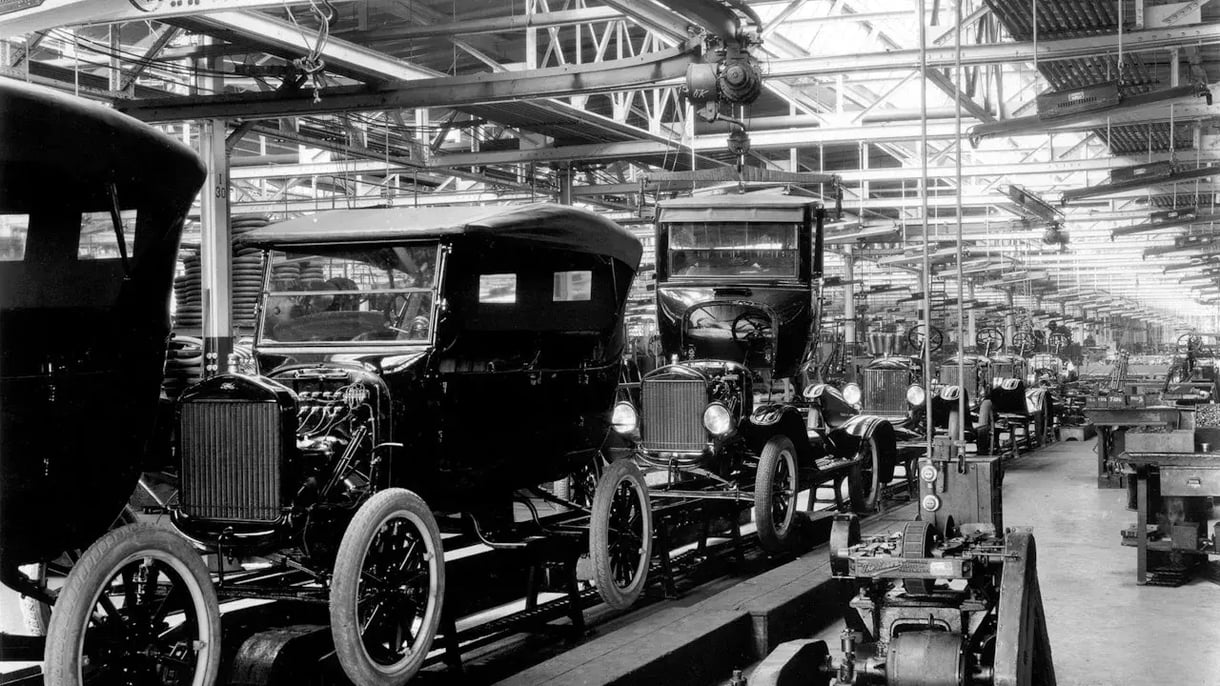
When Henry Ford began producing cars using an assembly line at the beginning of the last century, he introduced an innovation with unprecedented impact. Before adopting this approach, he focused on customer needs, technological possibilities and process optimisation. Yet Henry Ford acknowledged that if he had listened directly to his customers, he would merely have sold an improved version of the ‘horse and cart’. What can we learn from this?
What Henry Ford understood better than anyone else - even his own customers - was that consumers wanted a fast, reliable, comfortable and affordable way to get from point A to point B. This means of transport also had to be accessible to everyone. In Europe, the car had already demonstrated its comfort, speed and reliability. The challenge was to make cars affordable and standardise production by simplifying their components. Introducing the assembly line made it possible to create specialised teams responsible for just a few components. This represented a major improvement in the production process. In the middle of the last century, Toyota refined this process through its ‘Kato’ approach: teams took ownership of their component within the production process, becoming an essential part of the overall operation. Here, we see a shift from the ‘craft’ model, focused on producing the entire product, to the ‘operational excellence’ model, which makes production more efficient through focus and ownership.
"What Henry Ford understood better than anyone else - even his own customers - was that consumers wanted a fast, reliable, comfortable and affordable way to get from point A to point B"
How can we apply these principles to successful software development?
Over the past few years, many different processes and technologies have emerged in IT, including SOA, Agile, SCRUM, Cloud, Microservices, data-driven approaches and container technology. All of these can help make IT successful by simplifying the delivery process. However, implementation is often left solely to the IT department, without sufficient alignment and collaboration with the business. These processes and technologies cannot meet the organisation’s needs on their own. They require implementation by both the business and the IT organisation.
"These are all processes and technologies that can help make IT successful by simplifying the delivery process."
There are four drivers for successfully moving from ‘craft’ to ‘excellence’:
1. External customers, markets and supply chain partners have needs and requirements that make technological change necessary or desirable.
2. The internal organisation wants to improve productivity by changing its structure and culture, strengthening the intrinsic motivation to improve.
3. Ownership of operational processes is placed at the lowest level of the organisation, within small teams.
4. The ability to invest in new technology.
Architecture as the most important factor
These four drivers can be aligned by choosing the right architecture. This architecture must guarantee the autonomy needed to exercise ownership, facilitate alignment between domains and teams and, most importantly, meet the needs of external customers, markets and/or supply chain partners. Just as with the first Ford Model T assembly line more than a century ago. Domain Driven Development (DDD) is particularly well suited to this.
Why would Henry Ford have chosen ‘Domain Driven Development’?
This architecture brings the organisation, processes and technology together, as Ford’s and Toyota’s assembly lines did. These processes and technologies are reflected in the DDD architecture. It is based on domain teams delivering business subprocesses, in the form of microservices, to a company’s digital assembly line: the platform. These are small, permanent, autonomous teams made up of representatives from the business, data and IT organisations.
Successful implementations of a DDD architecture rely on:
A business need for change across the organisation
Autonomous domain teams empowered to take ownership
Domain boundaries that clearly define responsibilities
Microservices to accelerate service development
Event-driven architecture to keep data consistent
Containers to simplify software development and operation
Architectures to ensure alignment
Should you change your architecture straight away?
No, your customers, markets and supply chain partners must also be able and willing to change. Your own organisation must also be ready or prepared for the transition. Other architectures can be successful when driven by different factors. We can help make your transformation into the 21st century a seamless one.
"Would you like to know more about implementing an effective architecture for your organisation? I’d be happy to tell you more."