A reliable network is mission-critical for Vancis. To better support its customers, there was a need for a new monitoring platform that would provide greater insight and enable more proactive operations than the existing system.
In collaboration with Conclusion Xforce, Vancis worked towards the migration to Checkmk. The result: a solid foundation for automated monitoring and new insights that go beyond technology alone.
For an organisation responsible for keeping the systems of dozens of healthcare and education clients running, blind spots are not an option. Vancis, a cloud provider primarily active in these sectors, had relied on Nagios as its monitoring tool for many years. What once started as a useful extension of a legacy management system had gradually evolved into a complex and unwieldy setup.
“Eventually, you end up with a system that no longer fits today’s monitoring requirements,” says Danny Teffer, Senior Project Manager at Vancis. “We did explore whether we could redesign Nagios, but that option was ruled out as well. At that point, we decided as an organisation to move to Checkmk.”
The decision was not made lightly. A Vancis committee evaluated multiple vendors, conducted a proof of concept (PoC) with two customers, and concluded that Checkmk was the best fit. One thing, however, was immediately clear: implementation could not be done alone.
“Checkmk is a product built by engineers, for engineers,” Danny explains. “You can see that in everything. Without experience, implementation is simply not feasible. We knew we needed external expertise.”
Support for the implementation of Checkmk as a replacement for Nagios came from Conclusion Xforce, in particular through Monitoring Consultant Antoine Beerens. Conclusion Xforce was already a familiar partner to Vancis, providing licences for their previous monitoring setup and offering occasional support, but this project significantly deepened the collaboration.
“From the moment we came on board, we started from the ground up,” Antoine explains. “We began with a thorough analysis, mapping out Vancis’ requirements and objectives. Only then did we move into the build phase. In my view, that’s exactly how it should be done, although not always how it happens in practice.”
The PoC with two clients—one in healthcare and one in education, played a key role. “Even at that stage, we were already thinking ahead,” says Wesley Heijnen, Network Engineer at Vancis. “One of our requirements was to give customers direct access to the monitoring environment.”
This proved achievable. Danny explains:
“We now have a hierarchical setup in place. A master runs in the data centres where our infrastructure is hosted, while separate proxies are deployed for customer-specific environments. This allows customers to monitor their own systems through a web portal, without us having to expose anything externally. From a security perspective, that’s a significant advantage.”
"Their ambition to automate monitoring as much as possible reflects Vancis’s high level of ambition."
Antoine Beerens
Observability Consultant Conclusion Xforce
A notable aspect of the approach was the strong focus on automation.
“What I find impressive about Vancis,” Antoine says, “is their ambition to automate monitoring as much as possible. It means you’re willing to invest and not be tempted by short-term results. You’re choosing a high level of ambition and that pays off in an environment of this scale.”
He continues:
“From the very beginning, it wasn’t just about the technical implementation, but also about the question: how can we automate deployment going forward? Whether within Checkmk itself or through integrations with other tools. That mindset has delivered significant value.”
The implementation demanded a lot from Vancis’s teams.
“Checkmk comes with a steep learning curve,” Antoine explains. “An important part of my role was to train Vancis engineers, not just technically, but also in the underlying philosophy: how do you design it in a way that keeps it manageable and reproducible?”
Engineers at Vancis were heavily involved, often without immediately seeing tangible results. This occasionally led to impatience.
“We developed a template together that captured all our requirements,” Danny says. “But it took quite some time before we saw actual results. At one point, most of the outcome only existed in Antoine’s head. That sometimes led to frustration, you invest a lot of effort without yet seeing the return. In hindsight, that’s an important lesson: make results visible earlier to maintain momentum.”
That tension was also felt within the team.
“Colleagues would ask: what exactly are you working on?” Wesley adds. “You’re investing in fine-tuning, but you don’t see much yet. Now that the templates are ready, you can deploy configurations in just five minutes. That’s the moment when everyone recognises the true value of the work.”
"We can now manage more proactively and have more meaningful conversations with our customers."
Wesley Heijnen
netwerk engineer Vancis
Wesley adds: “We realised we had insufficient visibility into our network. So we went back to basics: what do we actually want to monitor? From there, we built templates. For instance, we discovered that certain ports were experiencing excessive attenuation, which we’re now properly alerted on. We now have deeper, real-time insight into our network and environment. As a result, we can manage more proactively and have more meaningful conversations with our customers. We know exactly what’s happening, and we see it instantly on our dashboard.”
For Antoine, that’s at the core of it:
“Designing solutions for complex challenges so that you get exactly the right signals, aligned with how an organisation operates. For Vancis, that also meant mapping out their ticketing processes and escalation flows. Who needs to be involved when something goes wrong? Even during the night? And what happens if that person doesn’t respond? Within Checkmk, we translated those business processes into technical workflows. The right alerts now reach the right people immediately.”
The transition to Checkmk proved to go beyond monitoring alone.
“Because we had to think at the process level, broader questions started to surface,” Danny explains. “What is each customer actually allowed to do? Who is responsible for what? That brought a lot of clarity, not just in monitoring, but in related processes as well.”
Wesley recognises this impact:
“It triggered a lot internally. We have customers who have been with us for over ten years. Through the onboarding, we had to take a fresh, critical look at what had been set up for them and what was defined in the SLAs. It gave us valuable insights and helped us regain full control.”
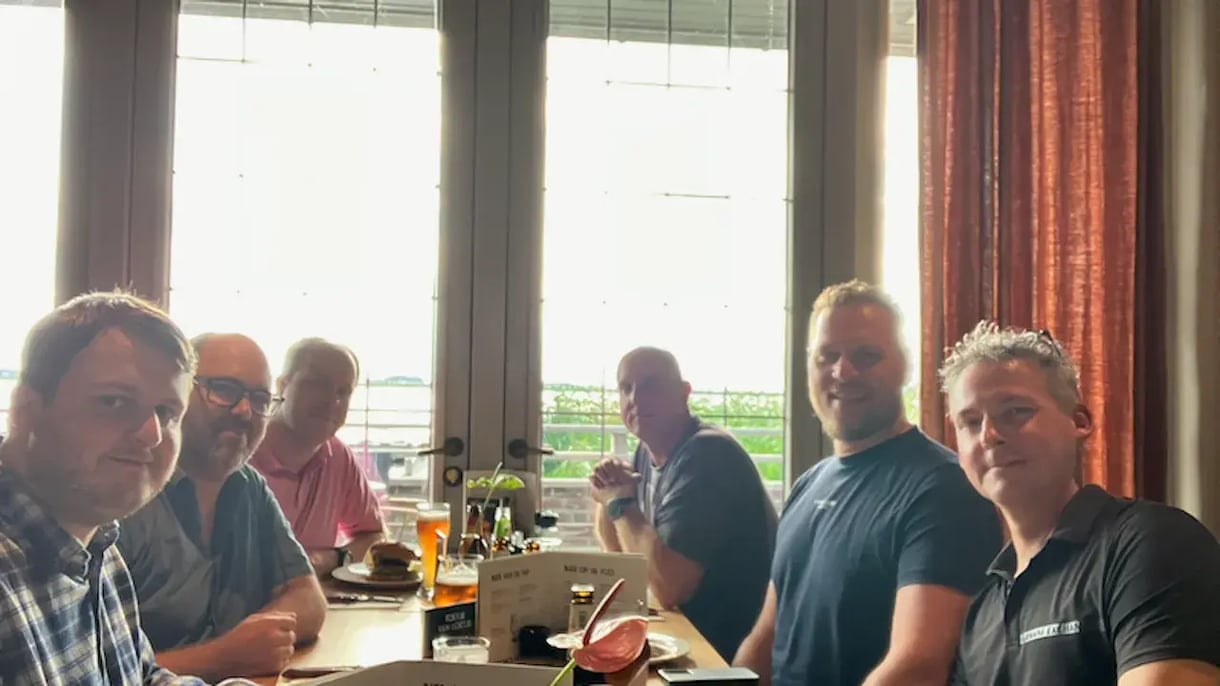
What began as a licensing provider offering occasional support evolved into a true partnership. Monitoring Consultant Antoine became a regular presence at the Vancis office, working alongside the team on a weekly basis. “It felt as if Antoine was simply one of our colleagues,” Wesley says.
The core implementation has now been completed and was celebrated together. Vancis currently operates with a team of four engineers, dedicating two days per week to the continued rollout. The goal is to have all managed assets and customers transitioned to Checkmk by the end of 2025. This will be followed by the phased retirement of Nagios and the development of custom solutions and specialised use cases.
“We’ll undoubtedly be sitting down with Conclusion Xforce again,” Danny says, adding with a smile: “Antoine, you’re not getting rid of us just yet.”
Antoine responds:
“That’s exactly the intention. We don’t deliver and then walk away. We aim for a long-term partnership, continuing to support Vancis with expansions, incidents, and any questions that arise.”
Danny concludes:
“Conclusion Xforce hasn’t just implemented the infrastructure, they’ve also empowered our people. It’s great to see how quickly our engineers have embraced Checkmk. I’ve been genuinely impressed by how fast they’ve made it their own.”
Are you ready to accelerate?
Accountmanager Projecten & Services