Onderzoeksrapport Business transformatie cover (1)-1-1
  • Author

    Conclusion

    |
  • Theme

    Business transformation

    |
  • Publish date

    6 October, 2026

    |
  • Deel

not fit for the next five years, say most C-level executives

Current board composition

CIO and Chief AI Officer expected to become more important than the CEO over the next five years 


Almost two-thirds (65%) of Dutch C-level executives believe their current board composition is not sufficiently equipped to deal with the challenges of the next five years, as technology and AI continue to reshape markets at pace. This emerges from our research among 663 Dutch decision-makers, including both board-level executives and middle management. The finding is particularly striking because it comes from board members themselves. Middle management agrees, although they are less critical, with 48% sharing this view. 

Doubts are emerging

These concerns do not exist in isolation. More than six in ten (61%) decision-makers believe their current board possesses sufficient technological expertise to steer these changes effectively. Among C-level respondents, this rises to 76%. In other words, boards have confidence in their own knowledge but question whether their overall composition is right for the future. 

What is clear is that technology itself is not seen as the biggest obstacle to transformation. Almost three-quarters (73%) of decision-makers identify leadership and organisational culture as the real barriers. Both C-level executives (78%) and middle management (70%) are aligned on this point. 

A changing boardroom

If leadership is the main constraint, the question becomes who will provide that leadership in the years ahead. This has significant implications for boardroom composition. While the CEO currently occupies the most prominent position in many organisations, the role falls to fourth place (27%) when respondents are asked which boardroom functions will be most important in the future. The top position is held by the CIO (Chief Information Officer) at 37%, followed by a chief AI officer (33%) and a chief transformation officer (28%). Notably, 72% of respondents consider the chief transformation officer role indispensable within modern organisations. 

Decision-makers show broad agreement on the skills future boards will require. Digital and AI expertise are identified by almost half (48%) as the most distinguishing capabilities, followed by strategic thinking in a rapidly changing environment (43%) and adaptability (42%). 
Over vaardigheden die de board van de toekomst moet hebben, zijn de beslissers het redelijk eens. Digitale kennis en AI-kennis worden door bijna de helft (48%) aangewezen als meest onderscheidende competentie, gevolgd door strategisch denken in een snel veranderende omgeving (43%) en aanpassingsvermogen (42%). 

Self-awareness without action

Boards recognise that they may need to be structured differently in the future, yet they also consider themselves sufficiently capable for the present. This tension is reflected in how C-level executives and middle management assess their organisations' position relative to the market. Almost a quarter (23%) of C-level respondents believe their organisation is clearly ahead of the market in terms of its ability to adapt. Among middle management, only 7% share that assessment.

"Nearly three-quarters of respondents consider a chief transformation officer indispensable to their organisation, and that figure alone should be a wake-up call for leadership teams."

Thijs Otto van Es

Managing director Conclusion Strategies
Thijs Otto van Es, Managing Director of Conclusion Strategies: "Nearly three-quarters of respondents consider a chief transformation officer indispensable to their organisation, and that figure alone should be a wake-up call for leadership teams. Organisations are not looking for another IT role. They are looking for someone who can bring together strategy, people, culture and technology. Any organisation that takes business transformation seriously should ask itself one question: who plays that connecting role in our organisation, and does that person already have a seat at the board table?" 

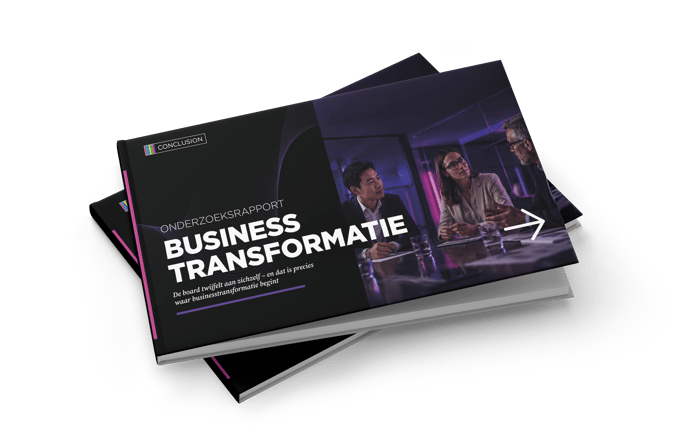
Mockup-Onderzoeksrapport-Businesstransformatie-NL-1

Research report:
Business transformation

Is your board ready for the next five years?

Our research among 663 Dutch decision-makers reveals that the biggest challenges are not technological, but related to leadership, decision-making, and turning strategy into execution. Discover which roles, capabilities, and organizational choices are critical for achieving successful business transformation.

About the research 

The research was conducted by Markteffect on behalf of Conclusion between May and June 2026. A total of 663 respondents participated, including 237 board-level or C-level executives and 426 middle managers, all employed by organisations with at least 50 full-time employees. Respondents represented eleven sectors, including financial services (15.4%), manufacturing (15.2%), retail (14.9%), government and public sector organisations (14.3%), professional services (10.9%), transport and logistics (8.7%) and ICT/IT (7.7%). 

Let's connect

Curious about what the findings of this research mean for your organization? We'd be happy to explore your challenges, ambitions, and next steps in an informal, no-obligation conversation.

Thijs van Es

Thijs Otto van Es

Managing director Conclusion Strategies