The early adopter:From AI experiment to true maturity
AI is hot—everyone wants a piece of it. More than half of Dutch organisations even consider themselves early adopters of AI. This is one of the findings from recent research into how AI leads within Dutch organisations are engaging with the technology. It suggests that Dutch businesses are fully immersed in the AI revolution. But look closer, and a more nuanced picture emerges only 15 per cent have integrated AI into their processes. This raises the question: what does it really mean to be an early adopter? And more importantly: how do you make the leap from experimentation to genuine AI maturity?
Beyond the experimentation phase
The enthusiasm is palpable. Dutch organisations clearly see the potential of AI and are actively experimenting. This phase is valuable—it helps organisations understand AI and identify where the technology can add value to their business.
However, somewhere between the first pilot and full-scale transformation, a gap remains. While 52 per cent label themselves early adopters, only 30 per cent report having implemented successful AI initiatives, and just 15 per cent have fully integrated AI. The journey from experiment to enterprise-wide implementation is proving to be a long one.
Four critical shifts
So how do you move from experimentation to true AI maturity? It requires four fundamental shifts.
First, successful AI deployment demands sharper prioritisation. Many organisations spread their AI efforts too thinly—some automation here, a bit of data analysis there. The result? Minimal impact. AI-mature organisations make bold choices and focus their resources on core processes where AI can deliver the greatest value.
The second shift is from AI as an “IT project” to AI as an organisation-wide capability. The research shows that 33 per cent cite lack of knowledge as their biggest challenge, while 44 per cent have yet to train staff in AI literacy. That’s a problem. Organisations must invest in multiple levels of AI understanding—from basic awareness for all employees to strategic insight for leadership. Without broad-based AI literacy, initiatives remain siloed in IT departments and AI never truly becomes part of how people work and think.
Third, fundamental transformation requires effective change management. The research reveals a paradox: while 54 per cent of AI leads say their employees see AI primarily as an opportunity, 38 per cent report fears about job loss due to AI. AI-mature organisations invest in transparent communication about AI’s impact. Only when employees truly understand how AI will change their work can they become partners in the process rather than opponents.
The fourth shift: from compliance to value creation. While 51 per cent believe AI should be more tightly regulated, only 27 per cent actually consider ethical principles in their use of AI. That’s short-sighted. AI-mature organisations view ethics not as a constraint but as a compass that reflects their corporate values. They use ethical frameworks to make better decisions about AI applications and build trust with customers and employees.
Show your true colours: who are you in the AI landscape?
Not every organisation needs to adopt AI at the same pace. Some are naturally cautious, while others position themselves as visionary pioneers willing to take big risks. Both approaches can be successful—provided they align with your organisational culture and ambitions.
The danger arises when organisations misjudge their own profile and set unrealistic expectations. A pragmatic innovator who compares themselves to a visionary pioneer may become frustrated with their own pace.
What’s your next step?
For organisations ready to move from experimentation to maturity, a few questions are essential. Which AI initiatives have truly added value? What can be scaled across the organisation? And: have we sufficiently engaged the organisation in our AI ambitions?
AI maturity is not a final destination, but a continuous journey of learning and adaptation. Organisations that consciously embark on this journey—with a clear vision, solid knowledge-building and attention to the human dimension—will be the ones to bridge the gap between experimenting with AI and creating real value. Because ultimately, it’s not about the label “early adopter”. It’s about whether you can use AI to truly move your organisation forward.
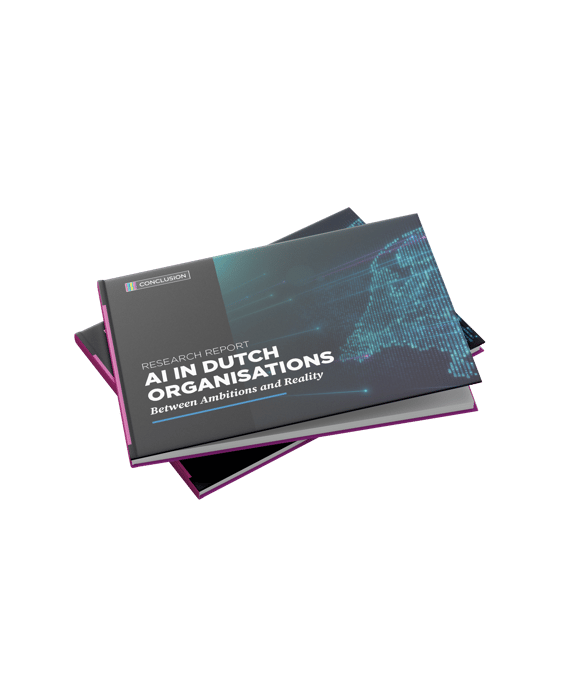
Research report AI in Dutch organisations
AI is no longer a vision of the future—it is a strategic imperative. Discover how Dutch organisations are embracing AI, where they see opportunities, and which obstacles they encounter on the path towards mature AI adoption.



.jpg?height=234&name=1733258772-6f0a2453%20(1).jpg)