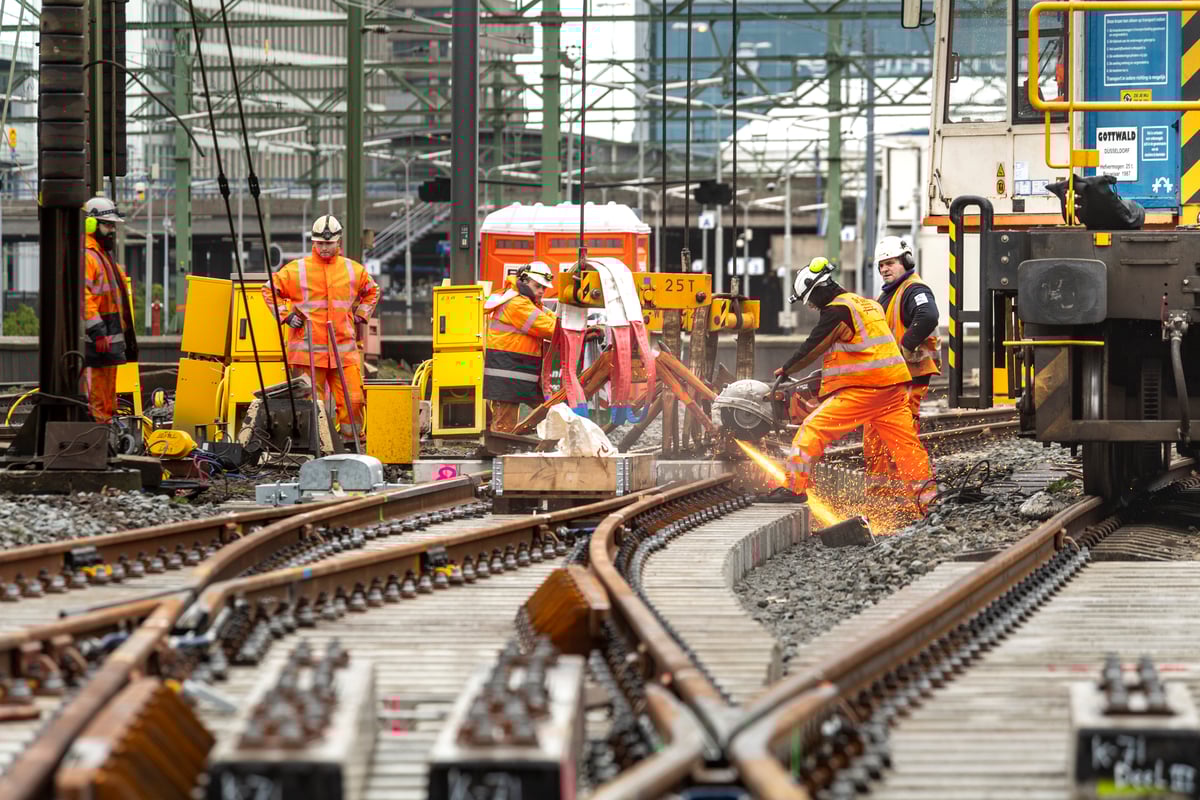
Behind the busy Dutch railway network lies a world of technology, processes and people who work around the clock to ensure safe and reliable infrastructure. Arjen Boersma has been at the heart of it for the past eighteen years. In various roles, he helped build a stable foundation for digital renewal. As he prepares to leave ProRail on 31 December, he looks back on IT’s evolution, the value of steady growth and the importance of working with the right partners.
“When I joined ProRail in 2008, the IT organisation still had to be partly established and built up. IT was fragmented, with components spread across multiple departments. We needed more cohesion and better performance. Particularly in the missioncritical area: services provided to rail operators. That was a challenge. Eventually, we developed a professional IT organisation with 99.998 percent availability.”
Two chains
Major strides were made in the years that followed. Arjen explains: “After centralising operations, we shaped the agile transition and aligned our services with ProRail’s two main chains: logistics assets. The first deals with train operations: from planning and execution to incident response. The asset chain covers everything needed to design, build, and maintain the railway. It’s a dataintensive chain involving numerous internal and external stakeholders; from engineering firms to rail contractors.”
Telecom provider
Another key area is infrastructure and operations. “What many people don’trealise is that ProRail is the third-largest telecom and fibre provider in the Netherlands, specifically for the railway. This supports the train protection system, communication between train crews and traffic control, and all the connectivity for passenger information displays. Fibre runs along the entire railway, branching out to switches,signals, tunnels, and bridge controls. Communication runs via platforms that have to be available 24/7. A fault not resolved within fifteen minutes disrupts the entire train schedule.”
“A Windows update used to take a year”
Microsoft environment
Office automation is also crucial to ProRail’s performance, Arjen notes. “Fifteen years ago, availability was poor. You’d switch on your laptop, go grab a coffee and wait for it to boot.” Things changed with a redesign of the environment. “I remember someone from Conclusion sketching out what the office environment should look like. We implementeditaccordinglyand performance improveddramatically.”
Cybersecurity
The Microsoft environment was migrated to the cloud, with an extra focus on cybersecurity. “As we manage vital infrastructure, system security is a top priority. Incidents often start with users, so the office environment has to be the first line of defence. That’s been set up well,” says Arjen. Custom-built applications were phased out: “We used to have a lot of bespoke software. A Windows update could take a year. Now it’s done in a day.”
Mission-critical
This ‘no customisation unless essential’ approach was extended to IT platforms. “We returned to standard solutions, so applications now run on generic platforms. That simplifies management and improves performance—crucial for our missioncritical IT.” The service desk was also professionalised. “We set up a fully skilled service desk, staffed 24/7 by external Conclusion employees. They know the organisation and understand the urgency of incidents. It feels like workingwithinternalcolleagues.”
Looking ahead
“Without IT, no train runs,” says Arjen. “Even though availability is higher than ever, you’re only as good as your last major disruption. My predecessor used to say: ‘Operational availability is the foundation you float on. If that’s not in order, you won’t get the chance to innovate.’”
‘Digital on track’
Arjen’s successor will face new challenges. “We’ve developed a digitalisation vision focused on technological renewal—from data-driven maintenance and digital protection systems to real-time distribution and control. The roadmaps are ready, so my successor can hit the ground running.”
ProRail stands to benefit greatly from data-driven operations, Arjen adds. “AI can automate lots of different processes, especially those that are information-heavy, sequential, and repetitive. There are also opportunities for standardisation in both internal and external execution. Tools are improving all the time, making processes more efficient. But to make that work, the data chain must be strong, and governance has to be well organised. There’s still work to be done.”
“With AI, you can automate knowledge intensive processes”
Metro network
The railway is increasingly resembling a metro network. Running more trains on existing tracks calls for smart and creative solutions. Arjen: “That’s why you want to work with partners who are adaptive and quick to respond to change.”
“We’ve worked with Conclusion for fifteen years, through constantly changing circumstances. That makes the collaboration different for me,” says Arjen. “There have been ups and downs. But if you can speak openly and come out stronger, that’s a partnership. For me, it’s not an empty term— it’s something you build together.”
With over 5,000 employees, ProRail manages and develops the 7,000-kilometre Dutch railway network. On an average day, 3,800 trains run across it, carrying more than 1.1 million passengers and around 100,000 tonnes of freight.
About Arjen Boersma
Arjen joined ProRail in 2008 to structure the ICT operations and improve service quality. After various advisory and management roles, he became head of the CIO Office in 2015 and ICT Director and Executive Committee member in 2020.
Your guide to digital transformation Discover DIFFERENT
Digital transformation challenges organisations to raise their game. It means embracing AI, ensuring data integrity, defining cloud strategies, driving technological sustainability, and meeting the growing demand for highly personalised services.In DIFFERENT, you’ll find insights into 10 critical themes, inspiring real-world stories, and sharp expert perspectives.
Dare to do things differently. Request your copy of the magazine and take the lead.