
AI-generated
AI-generated
Board believes strategy is landing,
More than four in ten Dutch managers (43%) say that corporate strategy is not translated into concrete action on the work floor. This comes at a time when technology, AI, geopolitics and regulation are forcing organisations to change rapidly. The findings come from our research among 663 Dutch decision-makers, spanning both C-level executives and middle management. The view from the top is very different: 82% of C-level executives believe that strategy is translated effectively into practice.
Bringing employees along with change
A strategy only takes hold if employees move with the change. Here too, perceptions differ. According to 84% of C-level executives, the board has a clear vision of how employees should be brought along through change. Middle management is considerably less convinced: just over half (54%) recognise that vision.
The same pattern emerges when it comes to having the freedom to implement change. More than eight in ten C-level executives (86%) believe managers have sufficient decision-making authority, compared with 63% of managers themselves.
Where the disconnect lies
C-level executives and middle management point to some of the same causes behind the faltering translation from strategy into execution. Almost four in ten cite a lack of clarity in translating strategy into execution (39% of C-level executives and 36% of managers). Around a third also point to the board being insufficiently involved in day-to-day operations, cited by 34% and 36% respectively.
On one point, however, opinions diverge sharply. For almost half of C-level executives (43%), a lack of shared language around the subject is the main cause. Middle management sees things differently: at 20%, this issue sits at the bottom of their list. The board therefore sees communication as a key part of the problem, while middle management takes a different view.
Confidence remains high at the top
These issues appear to have little effect on confidence at the top. Of C-level executives, 82% believe the board has a realistic view of where the organisation stands in its transformation, compared with 54% of managers.
That confidence also extends to their own role. Nine in ten C-level executives (90%) believe they are capable of leading their organisation through a transformation, compared with 71% of middle managers.
Thijs Otto van Es, Managing Director at Conclusion Strategies: “The boardroom and middle management are looking at the same organisation, but they each see a different picture. If those at the top believe the direction is clear and managers have enough room to act, while managers themselves do not experience it that way, execution grinds to a halt. You cannot keep asking managers to embrace change if they do not understand why decisions are being made, or feel they have too little room to act on them. A strategy only has value if it provides direction in the real world. So be clear in the choices you make and strong in execution. Explain why you are making those choices and have the conversation with your middle managers. That conversation matters at least as much as the strategy itself. That is where we help boards: from strategic direction to the work floor, staying involved until the results are there.”
Researchreport:
Business transformation
Is your board ready for the next five years?
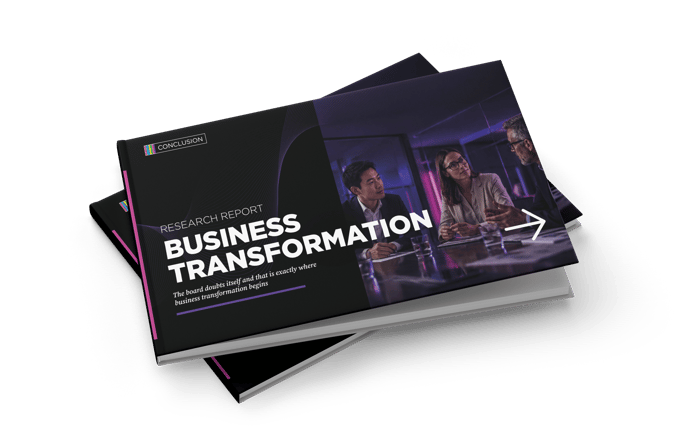
Our research among 663 Dutch decision-makers reveals that the biggest challenges are not technological, but related to leadership, decision-making, and turning strategy into execution. Discover which roles, capabilities, and organizational choices are critical for achieving successful business transformation.
About the research
This research was conducted by Markteffect on behalf of Conclusion between May and June 2026. A total of 663 respondents took part: 237 at board or C-level and 426 in middle management, all working for organisations with at least 50 FTEs. Respondents represented eleven sectors, including financial services (15.4%), manufacturing (15.2%), retail (14.9%), government and semi-government organisations (14.3%), professional services (10.9%), transport and logistics (8.7%) and ICT/IT (7.7%).
Let's connect
Curious about what the findings of this research mean for your organization? We'd be happy to explore your challenges, ambitions, and next steps in an informal, no-obligation conversation.

Algemeen directeur Conclusion Strategies