Dutch public wants AI taught in schools, with government taking the lead
28% want AI education to begin in primary school, while 22% believe schools should instead focus on learning without AI
67% of people in the Netherlands believe children should learn at school how AI works and how to use it responsibly: 28% want this to begin in primary school, while 39% favour starting in secondary school. These findings come from a nationwide survey conducted by Conclusion among 1,000 people in the Netherlands. When asked who should ensure that people have sufficient knowledge of AI, 46% named the government. By contrast, 22% believe schools should focus on learning without AI.
Secondary school is the more popular starting point, while 22% opt for learning without AI
Secondary school (39%) receives more support as the starting point than primary school (28%). Not everyone is convinced that AI education is necessary: 22% of people in the Netherlands — more than one in five — believe schools should focus on learning without AI. A further 4% consider AI education entirely unnecessary, while 7% are unsure.
Government expected to lead, with tech companies barely mentioned
Who should ensure that people in the Netherlands have sufficient knowledge of AI? 46% point to the government, through education and public information, followed by ‘individuals themselves’ (29%). Employers (9%) and tech companies (8%) are mentioned far less often, despite actively developing and deploying AI applications themselves.
Bastiaan Sjardin, Chief Technology Officer at Conclusion, says: “The government must ensure that the education sector itself sets the goals and quality standards for AI. Providers, in turn, must demonstrate that their systems meet those standards, protect educational data and safeguard privacy. Where applications influence grades or school recommendations, an external party should assess their reliability and check for bias and discrimination. Because freedom of opinion and access to diverse information are fundamental conditions for democracy, public and open alternatives are crucial. Genuine freedom of choice between suppliers must prevent a small number of commercial platforms from determining the direction of education.”
AI literacy as a core skill: the jury is still out
There is uncertainty about just how fundamental AI literacy will become. According to 39% of people in the Netherlands, five years from now knowledge of AI will be as important as reading and writing, compared with 25% who disagree. A further 36% are neutral. The idea of AI as a future core skill is therefore far from settled, even though 67% believe children should learn at school how AI works and how to use it responsibly.
“Using AI responsibly involves far more than learning how to write prompts,” Sjardin says. “Pupils and students need a sufficient understanding of how AI works, as well as its risks and limitations. They must learn to verify answers, assess the value of sources and decide when it is better not to use AI. Independent practice without AI remains necessary to develop knowledge and core skills. Teachers also need AI literacy if they use AI to create teaching materials, provide feedback or mark work. They remain responsible for checking the output and substantiating assessments themselves. Ultimately, what matters is what pupils and students themselves understand and can do. To achieve this, teachers need targeted training and a clear AI policy with practical guidelines for use in education.”
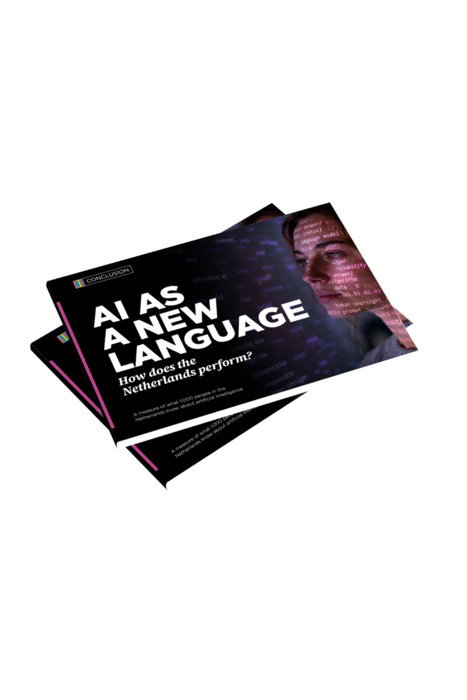
Researchreport AI as a new language
We are learning the language of AI at a rapid pace, but many of us are not yet fluent. On average, people in the Netherlands score just 5.1 out of 10 on our AI knowledge test. We recognise the terminology, but often lack a real understanding of how the technology works behind the scenes. Yet that understanding is essential for using AI responsibly. How AI-literate are you? Read our research report and take the AI knowledge test.