Digital Signage has been on the rise for years. It is a collective term for all forms of information and entertainment where you present (often dynamic) content on a screen. This screen could be anything from a price display on the supermarket shelf to the gigantic LED-covered Sphere in Las Vegas. Although the basic technology has been around for a while, this market is currently developing quickly.
“You see a split developing,” says Menno Pleij, Senior Industrial Designer at Conclusion ForeyeT. “On the one hand you have the ever-larger and brighter screens, and on the other, precisely the energy-saving solutions the market demands. The variety is increasing.” This is also in line with the ever-widening market. In the early years, digital signage was mainly used to convey information, but today you see more and more commercial applications. Consider for example the metre-high advertising columns along the motorway.
The different requirements in these different markets mean that the trends are often almost opposite. The most important trends are:
Emerging Technologies Tend Repport 2024
The Conclusion companies continuously monitor emerging IT trends and discover and explore new technologies that may be of interest to our clients. In our semi-annual trend report, we highlight several technologies that, in our opinion, deserve attention. Will you explore with us?
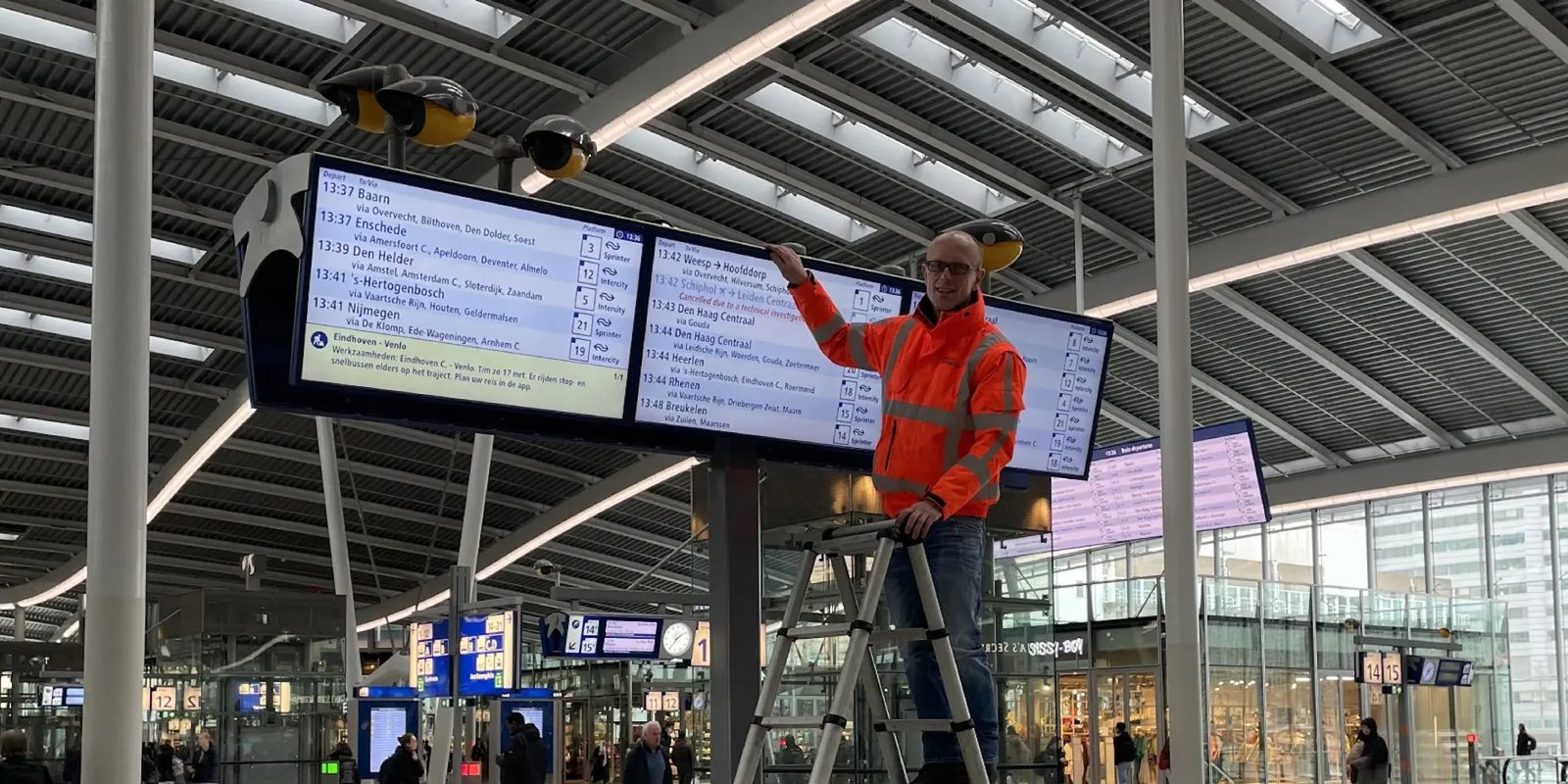
Conclusion ForeyeT specialises in the installation and 24/7 management of edge devices for various sectors. Aside from operators in the energy sector such as Eneco, we have also been partnered with ProRail and NS for all the screens and clocks at railway stations for many years. The conditions at those stations vary considerably, from covered halls to small platforms where the screens are exposed to the elements. “You might mostly think of wind, rain and cold, but the full sun in the middle of summer is much more problematic. On those days, the fans have to work extremely hard to cool the equipment,” says Menno.
The same screens have been used at most NS stations for 10, 15 years. Menno: “They’ve since become technologically outdated, but we’ve completely modernised them on the inside. We replaced various hardware components as well as the embedded software. By integrating sensors, we can now monitor the screens remotely even better. We see it when parts wear out, and then we can schedule preventive maintenance. We’ve also made sure that the screens use less energy. For example, we can switch them off when no trains are running, so then they don’t use any energy.”
For the physical installation work, Conclusion ForeyeT developed a mechanical tool that means it no longer takes three installers to replace a screen, but two people can do it. “A screen weighs almost 50 kilos and is positioned at an average height of three metres. When you replace them, you have to take safety precautions. We save costs by using the mechanical lift we’ve developed. This has proven very useful given the tight labour market,” says Menno.
This real-life example is a good demonstration of how wide-ranging digital signage is. If you want to present information on a screen, you have to make quite a few choices. The time has passed when the contractor would propose digital signage solutions as part of a complete package, as was common until recently. The solutions have now become so specialised that it pays to be well informed about things like the screen resolution required, energy consumption, predictive maintenance, and the possibility of upgrading existing screens to extend their lifespan.
“The screens become ever-larger and brighter, but now the energy-saving solutions are also being developed. The variety is increasing.”
Menno Pleij
Senior Industrial Designer at Conclusion ForeyeT