MANAGING COMPLEX DIGITAL CHAINS


Why Insight Alone Isn't Enough
Learn how observability, service integration, and automation work together to provide greater control over digital services.
Cover for the Observability Vision Paper-1

The challenge behind
complex digital services

A lot of insight, but little clarity

Behind every business-critical service lies a chain of applications, cloud environments, networks, suppliers, and internal teams. As a result, organizations have access to an ever-increasing amount of data and tools. Yet they often lack a comprehensive overview of the entire chain. Consequently, it is not always clear where a disruption originates, which components are affected, and what the impact is on service delivery.

Unclear leadership and responsibilities

Digital services are increasingly delivered by multiple teams, vendors, and technology partners. Each party has insight into its own area of expertise, but no one automatically has an overview of the entire picture. This leads to uncertainty regarding ownership, responsibilities, and decision-making. When a disruption occurs, it is not always immediately clear who should take action and what information is needed to do so.

Too Slow to Turn a Signal into Action
Detecting an anomaly is only the first step. Organizations must also understand what is happening, what the consequences are, and what action is needed. In practice, monitoring, service management, and automation are often set up separately. As a result, it takes time to interpret alerts, involve the right people, and take effective action.
"If you want to respond more quickly to change, you must also be able to observe, decide, and act more quickly."

Jochem van Lierop

CTO Conclusion: Mission-Critical

Jitse Klomp, Observability Expert
“Many organizations have one of the three disciplines well under control. However, it is precisely the connection with the other two that is often still lacking.”

Jitse Klomp

CTO Conclusion Xforce

Jochem
“If you want to manage effectively, you need to use observability, service integration, and automation in the right context.”

Jochem van Lierop

CTO Conclusion: Mission Critical
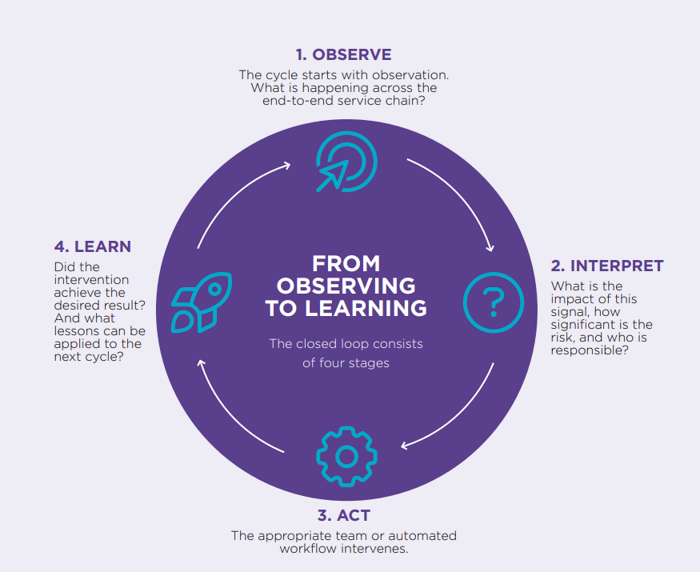
4-step model for Observability graphic

From Insight to Action

Many organizations have access to sufficient data, dashboards, and monitoring tools. Yet in practice, it proves difficult to quickly understand disruptions, clearly assign responsibilities, and take effective action. After all, insight alone does not automatically lead to better decision-making or faster action.

Observability, service integration, and automation together form a closed loop in which insight is transformed into control and action. By combining signals from the entire digital chain, clarifying responsibilities, and automating processes wherever possible, organizations gain greater control over complex digital services.

Download the vision paper

What does it take for organizations to stay in control in a landscape with an ever-increasing number of systems, suppliers, and AI applications? In this vision paper, we share our perspective on insight, control, and automation, supplemented with an examples from ProRail, as well as practical tips to help you get started.

Curious to see how this works for your organization?

Do you have a deep understanding of individual components, but lack an overview of the entire chain? Is it not always clear who should take action when a disruption occurs, or where automation can truly add value? Conclusion helps you connect the existing building blocks for observability, service integration, and automation and determine what a logical first step would be.

Would you like to know where your organization stands today and which next step will have the greatest impact? Our experts would be happy to work with you to find the answer.

Discover where your greatest opportunities lie

Our experts would be happy to work with you to address the challenges, opportunities, and next steps within your organization.

Bart Bruinsma

Bart Bruinsma

Commercial Director, Conclusion Mission Critical