With 21,000 colleagues, the Facilicom Group ranks among the leading providers of facility services and care & welfare solutions. Organisations rely on punctual service every day, which means business processes must run flawlessly. CIO Pieter Zeestraten offers a behind-the-scenes look at how data is delivering surprising added value.
“One of the most crucial elements is planning,” Pieter explains. The challenge lies in the many variables typical of facility services. “Our strength is placing the right colleague in the right spot, every time. That involves people with different collective labour agreements, contract types and working hours. What makes the puzzle even more complex is that our clients often have specific requests. We’re keen to meet them.”
Increasingly accurate
Technology helps manage this complexity. By collecting, combining and analysing data, the Facilicom Group can predict staffing needs with growing precision. Pieter: “Real-world conditions show us what influences staffing levels.” These factors range from weather, day of the week, season, specific dates and times, flu outbreaks, announced and unannounced traffic measures, to demographics and behavioural trends. “We learn more each time, and data helps us look ahead more effectively. Conclusion supports us with advanced data models.”
Axxicom airport caddy
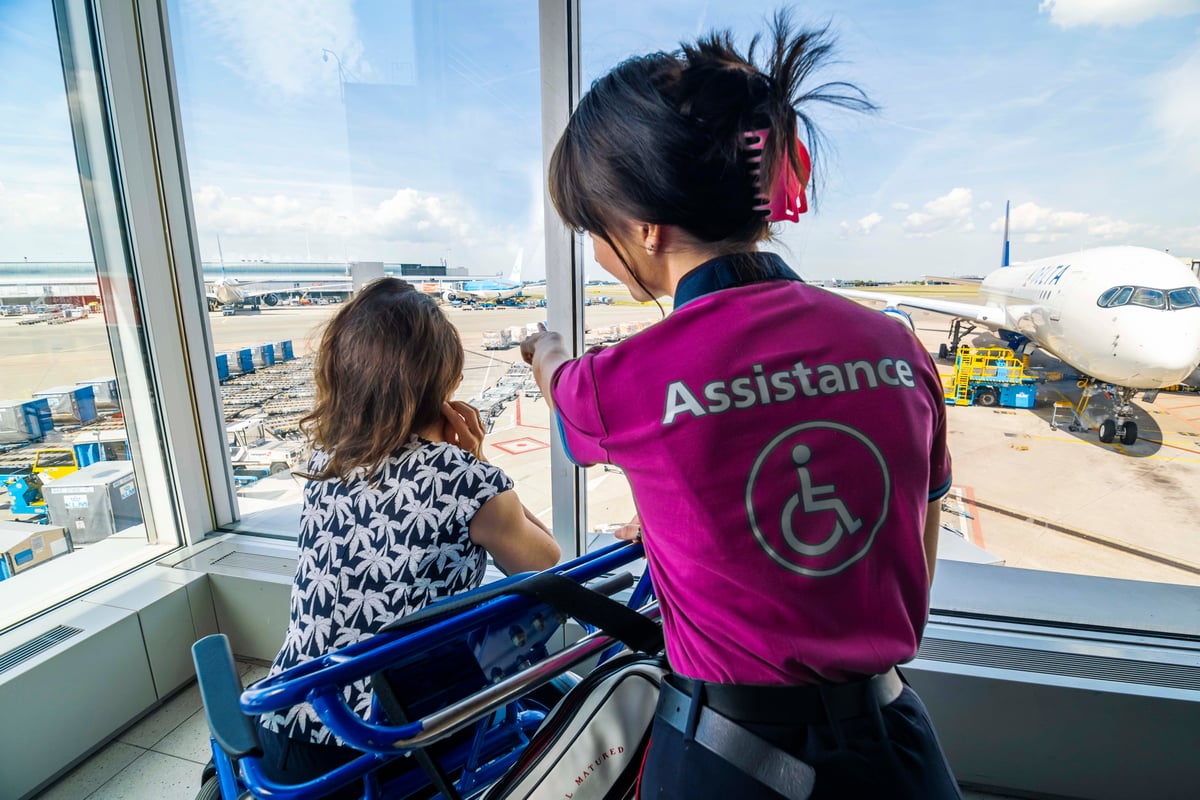
A striking example is the Axxicom Airport Caddy service at Schiphol, where passengers with limited mobility are assisted to and from the gate. Pieter: “You only know at the last moment how many passengers are going to need assistance. On busy days, it can be hundreds at a time, requiring far more staff on site than usual. Predictive models allow us to anticipate how busy it is going to be.”
"An unoccupied room is cleaned differently"
Reducing food waste
Another strong example is the use of sensors to measure office occupancy. “If a room hasn’t been used, it’s cleaned differently, whereas a busy meeting room receives a more thorough cleaning.”
In corporate catering, the Facilicom Group is developing predictive models to reduce food waste. “We want to forecast how many people are going to have lunch and what they’ll eat. That improves hospitality and helps us buy and waste less.” Maintenance of technical installations is also becoming smarter. By using data, the Facilicom Group can predict when a part needs replacing before it fails.
"Meaningful work is more fulfilling than unnecessary tasks"
More targeted service
Ultimately, this is not just about business efficiency, Pieter emphasises, but about people’s wellbeing. That’s what the Facilicom Group stands for. “Thanks to predictive models, our colleagues can offer more targeted service, which benefits everyone. At Schiphol, passengers can start their journey more comfortably and with less stress. And everyone appreciates a clean, comfortable space where everything works. It’s also far more rewarding for our staff to do meaningful work than to carry out unnecessary tasks.”
About Facilicom
The Dutch family-owned Facilicom Group consists of six divisions in the Netherlands and Belgium, offering facility services and care & welfare solutions:
A completely different challenge that the Facilicom Group is tackling with Conclusion is the implementation of AFAS as its ERP system. HR processes have already been migrated to AFAS, but according to Pieter the upcoming ERP transition of the entire business operation is comparable to open-heart surgery: “You don’t change the core of your operations lightly—it affects all financial processes; from contracts to planning and invoicing.” This keeps the need for custom software ‘light’.
"This transition is comparable to open-heart surgery"
Standard
Pieter and his team have deliberately chosen to use AFAS’s standard functionalities. “Our current solution has largely been shaped around our operations and ways of working. It just evolved that way. It sounds clever, but ultimately it makes everything sluggish, complex and costly to maintain. At some point, it no longer works as intended.”
Low-code
“If we do want to make adjustments within AFAS, we’re very critical. We only build something alongside AFAS using low-code in exceptional cases.” This is a form of software development using reusable components, allowing complex applications to be built quickly and integrated into existing systems. It keeps the need for custom software low.
A client-focused mindset
Pieter sees a parallel between the Facilicom Group and Conclusion: spotting opportunities and generating ideas. “There’s always room for improvement. Just challenge us. I don’t want yes-men around me. That means thinking in solutions, not problems, and challenging one another. Because that’s how we both grow. I don’t call suppliers partners for nothing.”
.jpg?height=800&name=P1053310%20(003).jpg)